Main Water Line Replacement Cost: Repair vs. Replace, Trench vs. Trenchless
A failing water service line usually means a choice between a spot repair and a full replacement, and between open trench and trenchless. Confirm who owns the line, then compare scoped quotes as planning estimates before work begins.
The short answer
My view: a leaking water service line is not always a full-replacement job, and the cheapest dig is not always the cheapest project. Decide who owns the line, match the repair to how much of the line is actually failing, and compare open-trench and trenchless quotes as planning estimates that include permits, utility locates, and restoration before you authorize any work.
A main water line carries potable water from the municipal main under the street, or from a private well, to the home. It supplies every fixture and appliance, so when it fails the whole house feels it. The pipe is often called the water service line, though precise cost and responsibility guides draw a distinction: the city's underground pipe is technically the water main, while the homeowner's line from that connection into the house is the water service line. Knowing which portion is failing, who owns it, and how it will be replaced is what turns one scary quote into several comparable ones.
In many communities the service line has two owners. The water utility usually controls the connection at the meter or street edge, while the homeowner typically owns the private section running across the property. That boundary varies by locality and by provider, so the only reliable answer comes from the water utility rather than a general rule. It also matters for lead: EPA's lead service-line inventory work treats both public (utility-owned) and private (property-owned) sections, because material such as lead can sit on either side of that ownership line.
Whether the job is a spot repair or a full replacement, and whether it uses open trench or trenchless technique, changes the price more than almost anything else. Permits, excavation, utility coordination, and restoring the yard, driveway, or sidewalk add real cost on top of the pipe itself. This guide explains how to identify the line, confirm responsibility, choose between repair and replacement, and compare scoped quotes using dated national planning estimates from Angi and HomeGuide.
Cost and effort
Plan the practical side
| When this usually fits | Typical scope | 2026 planning range | Next step |
|---|---|---|---|
| One isolated leak at a valve, fitting, or short pipe section | Repair or replace just the damaged segment | Angi lists main water line repair around $354 to $1,696 for most homeowners (national average about $1,025), with valve work from $150 and broken-pipe work up to $5,000 | Confirm how much of the remaining line is still in shape before committing to a narrow repair |
| Widespread corrosion, repeated leaks, or a line near the end of its useful life | Replace the service line rather than patch individual sections | Angi lists corroded-pipe repair at $600 to $5,000 because all affected material is removed and the line is often replaced in full | Ask for a replacement scope if failures are recurring rather than isolated |
| Widespread corrosion, repeated leaks, or a line near the end of its useful life | Replace the service line rather than patch individual sections | HomeGuide lists water line repair at about $400 to $1,500 on average | Ask for a replacement scope if failures are recurring rather than isolated |
| A line that is very old or severely damaged | Full replacement may be the only durable option | Replacement planning ranges appear in the method table below; HomeGuide's main water line total averages $2,000 to $5,000 for labor and materials | Compare open trench and trenchless scopes before choosing a method |
| Factor | Open trench | Trenchless |
|---|---|---|
| Cost per linear foot (Angi) | Angi about $50 to $150 per foot, up to $250 in high-cost or hard-to-access areas | Angi about $75 to $150 per foot |
| Typical total project range (Angi) | Angi lists open-trench replacement at roughly $1,500 to $13,000 for the method alone; Angi's overall main water line replacement typically runs $646 to $2,834 with a national average near $1,702 | Angi lists trenchless pipe lining at about $75 to $150 per foot |
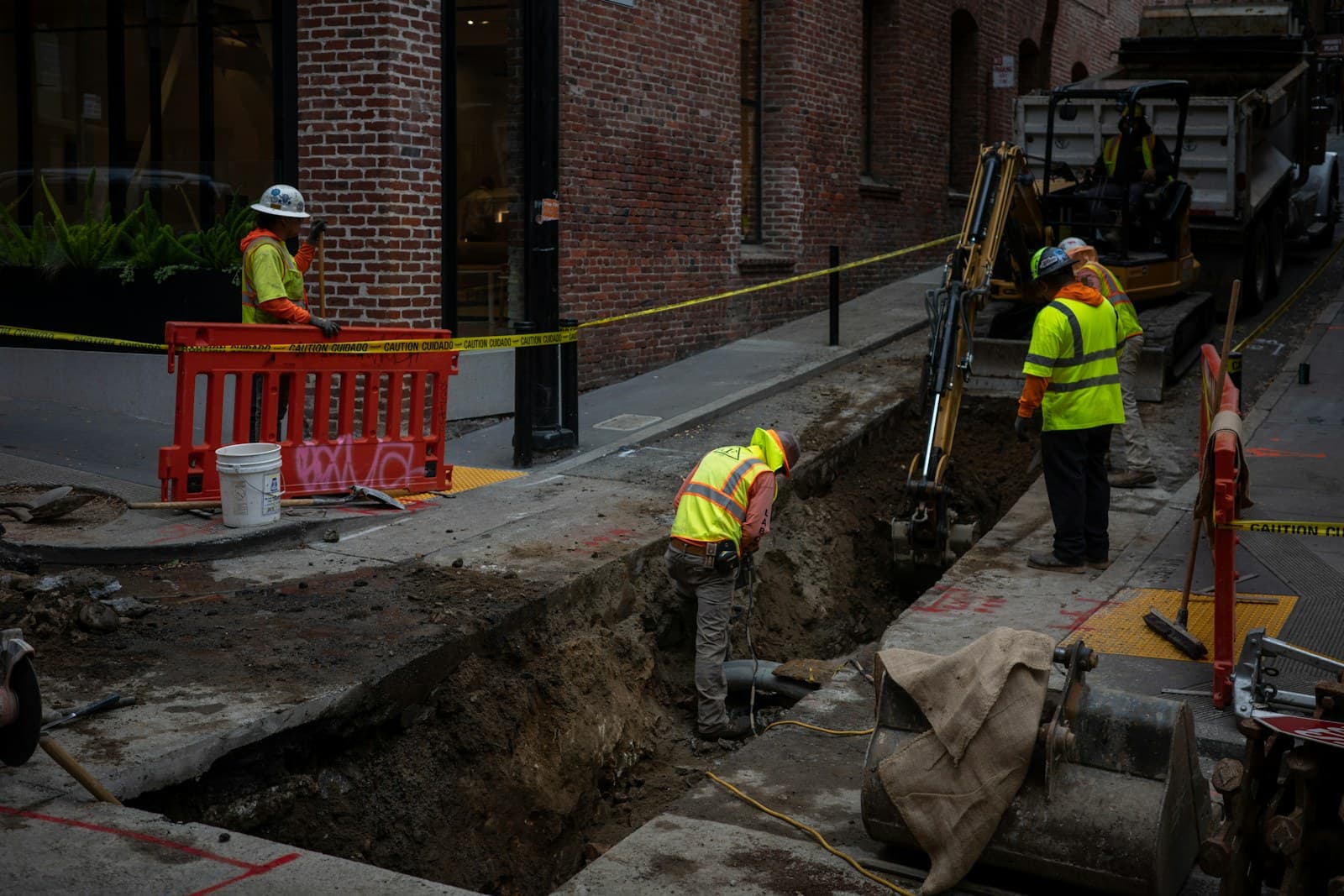
| Excavation and yard impact | Digs a trench across the property and often needs landscaping, grading, or hardscape repair afterward | Bores small entry holes and pulls new pipe through, so it usually needs little to no landscape or hardscape restoration |
| When it is usually chosen | Preferred when the line is inaccessible, collapsed, or blocked by obstructions that a trenchless tool cannot pass | Preferred in most cases because it avoids major excavation |
| Factor | Open trench | Trenchless |
|---|---|---|
| Cost per linear foot (HomeGuide) | HomeGuide about $50 to $200 per foot | HomeGuide about $70 to $250 per foot |
| Typical total project range (HomeGuide) | HomeGuide's main water line total averages $2,000 to $5,000 for labor and materials | HomeGuide trenchless methods include pipe bursting and epoxy pipe lining |
| Cost factor | 2026 planning range |
|---|---|
| Permits and inspections | Angi lists permit fees around $150 to $500; HomeGuide lists plumbing permits from about $30 to $500 and inspections from about $100 to $200+ |
| Excavation and equipment | Angi references an excavator operator near $120 to $150 per hour and trenching from about $400 to $1,200 |
| Landscaping and restoration | Angi references yard restoration around $3,500; HomeGuide references landscaping at about $50 to $100 per hour and major driveway repair up to $600 to $3,000 |
| Shut-off valve, regulator, or tap connection | HomeGuide references a shut-off valve replacement near $250 to $600, a pressure regulator about $150 to $350, and a tap connection about $300 to $500 |
| Depth and access | Lines may sit less than 3 feet deep in warm regions and 8+ feet in cold climates below the frost line; lines under a driveway, sidewalk, or rocky soil cost more to reach |
| Confirm before work | Ask for it in writing |
|---|---|
| Ownership and responsibility | The utility's written answer on which portion they own versus the property owner, especially past the property line |
| Permit responsibility | Who pulls the permit, whose name carries inspections, and the expected inspection steps |
| Method and why | Whether open trench or trenchless is proposed and the reason that method fits this specific line |
| Restoration included | What yard, driveway, sidewalk, or interior finish work is included and what costs extra |
| Utility coordination | That 811 locates are called and buried lines marked before excavation begins |
| Change work and warranty | How unexpected conditions are priced and approved, and what the warranty covers |
Locate the water service line and map its path
Trace the line from the meter or street connection into the home so you know roughly where it runs under yards, driveways, or near foundations. Note fixtures below or far from the meter, any past leaks, and obstructions such as large trees, rock, concrete, or deep frost. Symptoms that trace to this one line include weak flow at every fixture rather than one faucet, and a water bill that jumps with no obvious cause; both point here instead of to a single fixture. A clear map helps a contractor choose a method and estimate restoration.
- Find the meter and connection
- The meter box is usually near the street edge or property line; the private line runs from there into the house. Ask the utility where their portion ends if you are unsure, and learn how to locate and label your main water shutoff as part of the same map in case a line ever bursts.
- Note what sits above the line
- Driveways, sidewalks, mature trees, rock, and deep frost all change how a line is reached and restored. Record them before a method is chosen.
- Keep it a planning map, not a dig plan
- You are locating the path to compare scopes, not deciding where to excavate. Excavation belongs to qualified professionals who call locates first.
Confirm who owns which portion
Ownership of a service line often splits near the meter or street edge, and the boundary differs by locality and provider. Call the water utility and ask in writing which section they own versus the property owner, because an assumption can put an unexpected bill on the wrong party. This also matters for lead, since EPA's inventory work treats both public and private sections.
- Ask the utility directly
- Request a written answer on where ownership changes hands, especially past the property line. Angi advises this exact step rather than assuming responsibility.
- Check material if relevant
- EPA's lead service-line inventory distinguishes utility-owned and property-owned sections because lead can sit on either side of the boundary.
- Do not assume coverage
- A homeowner policy may cover sudden accidental damage but often excludes maintenance-related failure. Check the policy language; this guide does not promise a claim will be covered.
Decide repair versus full replacement
A single isolated leak may be a spot repair, while repeated failures, widespread corrosion, or a line near the end of its useful life usually point toward full replacement. The symptom alone does not decide scope; a qualified professional should assess how much of the remaining line is still serviceable before you choose a narrow repair against a whole-line replacement.
- Isolated versus recurring
- One leak at a valve or short section can be repairable. Recurring leaks across the line suggest the line itself, not one joint, is failing.
- Age and condition matter
- A line past its useful life or severely damaged may only be durably fixed by full replacement, even if a patch is cheaper today.
- Compare on scope, not price alone
- A cheap spot repair on an aging line can cost more over time than a scoped replacement. Weigh both against how much of the line remains in shape.
Get scoped quotes for open trench versus trenchless
Ask at least two qualified contractors to quote the same line, one using open trench and one trenchless if appropriate, so you compare like with like. Each quote should separate the pipe work from permits, excavation, utility locates, and restoration, because those add real cost on top of the replacement itself. Treat Angi's and HomeGuide's 2026 ranges as planning estimates for budgeting, not local bids.
- Permits and locates
- Confirm who pulls permits and that 811 is called so buried lines are marked before excavation. Not calling 811 is the leading cause of utility damage.
- Excavation and method
- Open trench digs a trench across the property; trenchless bores small holes and pulls new pipe through. The quote should explain why the proposed method fits this specific line.
- Restoration included
- Trench often needs landscaping, grading, or hardscape repair afterward. Ask what yard, driveway, sidewalk, or interior finish work is included and what costs extra.
Compare like-for-like and schedule with a written scope
Put every quote into one sheet with the same rows: method, permit responsibility, excavation, utility coordination, restoration, schedule, payment milestones, and warranty. A lower total that omits locates, permits, or restoration is not cheaper; it just hides the work. Comparing contractor quotes by scope rather than total price keeps those omissions visible instead of making a thin quote look cheap. Choose the scope that makes the job legible, then schedule only after the unknowns and change-work process are written down.
- Read the blanks
- A blank row is a question to resolve, not an item silently included in the lower price.
- Change work in writing
- Ask how unexpected conditions are priced and approved before non-emergency work proceeds.
- Keep the record
- Save the scoped quotes, permit and locate confirmation, and signed scope so a later leak or bill can be traced to a specific decision.
Put the guide to work
Field notes
- What the line is
- The water service line runs from the utility connection at the meter or street edge into the home and supplies every fixture. Precise guides call the city's pipe the water main and the homeowner's line the water service line, so terms are not always used exactly.
- Who owns which part (varies)
- Ownership of a service line often splits near the meter or street edge, and the boundary differs by locality and provider. Call the water utility to confirm who owns which section before assuming responsibility for a repair bill.
- Repair or replace signal
- One isolated leak may be a spot repair; repeated failures, widespread corrosion, or a line near the end of its useful life usually point toward full replacement. The symptom does not decide the scope by itself.
- Before any digging
- Anyone who plans to dig should call 811 a few days in advance so buried utility lines are marked with paint or flags. Process varies by state: contact 811 or your state center a few days before digging, then follow the ticket's waiting period, confirmation step, and any state-specific rules whether a professional or a homeowner digs.
- Read quotes as planning estimates
- National figures from Angi and HomeGuide are planning ranges for budgeting, not local bids. A written scoped quote that lists permits, excavation, utility coordination, and restoration is what you actually compare. For a running budget across several homeowner projects, the Maintenance Reserve Planner at /tools#maintenance-reserve gives one broad annual upkeep range to start from, then swap in known roof, system, and appliance timelines as the home file improves.
Common questions
Frequently asked questions
- What exactly is a main water line versus a water service line?
- The pipe that brings potable water from the municipal main under the street, or from a well, to the home supplies every fixture. Precise cost and responsibility guides call the city's underground pipe the water main and the homeowner's line from that connection into the house the water service line. The terms are often used interchangeably, but the distinction matters for ownership and cost.
- Who owns the water service line, the utility or me?
- Ownership usually splits at a point near the meter or street edge, with the utility controlling one side and the property owner the other, but the exact boundary varies by locality and provider. The only reliable way to confirm is to ask your water utility in writing, because assuming the wrong owner can put an unexpected bill on the wrong party.
- How do I know whether I need a spot repair or a full replacement?
- A single isolated leak at a valve, fitting, or short section may be repairable, while repeated failures, widespread corrosion, or a line near the end of its useful life usually point toward full replacement. The symptom alone does not decide the scope; a qualified professional should assess how much of the remaining line is still in shape.
- Is trenchless better than open trench?
- Trenchless avoids major excavation and usually needs little landscape or hardscape restoration, which is why it is often the first method considered. Open trench is usually chosen when the line is inaccessible, collapsed, or blocked by obstructions that a trenchless tool cannot pass. Neither is universally better; the proposed method should explain why it fits this specific line.
- Why does my quote differ so much from a neighbor's?
- Length and depth, soil and rock, whether the line runs under a driveway or sidewalk, local labor rates, permit fees, and how much restoration is included all change a total. National planning ranges are useful for budgeting, but only a written scoped quote for your own line can be compared directly.
- Do I need a permit and utility locates before the work starts?
- Most projects require a permit and buried utility locates. Contact 811 or your state center a few days before digging so buried lines are marked with paint or flags; the exact waiting period, confirmation step, and rules vary by state ticket, and not calling 811 is the leading cause of utility damage. Excavation should generally be handled by qualified professionals who carry permits and locates as part of the scope.
- How much does main water line replacement cost in 2026?
- Angi's 2026 guide lists main water line replacement at a typical range of $646 to $2,834 with a national average near $1,702, and HomeGuide's averages $2,000 to $5,000 for labor and materials. Per linear foot, Angi cites about $50 to $150 (up to $250 in hard-to-access areas) and HomeGuide $50 to $200 trenched or $70 to $250 trenchless. These are planning estimates, not local bids; a scoped written quote is what you authorize.
Use the findings
Open the detailed check for what you found
Make the next step useful
Put this guide on your home plan
Know when to call a professional. Stop if work involves active gas leaks, damaged service wiring, structural movement, unsafe heights, suspected contamination, or a problem you cannot confidently isolate.
Editorial review and sources
Reviewed by: Smart Homeowners Editorial Desk
Last reviewed: October 28, 2026
Original Smart Homeowners editorial; not adapted from a third-party article.
Source notes and limitations
- Definition and precision: HomeGuide's 2026 water line replacement guide notes that 'water main', 'main water line', and 'water service line' are often used interchangeably, but the city's pipe is technically the water main and the homeowner's line is the water service line. This article uses 'water service line' for the private line into the home.
- Responsibility varies: Angi's 2026 repair guide advises homeowners to call their town or city to determine who is responsible for the portion beyond the property line, and EPA's lead service-line inventory work treats both public (utility-owned) and private (property-owned) sections because lead can sit on either side of that boundary.
- Cost planning estimates: Angi figures were checked October 14, 2026 (replacement) and September 23, 2026 (repair); HomeGuide figures come from its 2026 guide updated December 2025. They are national planning ranges for budgeting, not local bids, and the article keeps each source's numbers separate rather than blending them.
- Safety and process: EPA lists an estimated 4 million lead service lines in the United States and treats inventories as the foundation for identifying material on both sides of the ownership boundary. 811 Before You Dig is the free national before-you-dig service that marks buried utilities; not calling it is the leading cause of utility damage, and shallow digging still requires a call.